ERRECI
Biochrom 30+
Biochrom 30 Automatic Amino Acid Analyzer
ERRECI is pleased to present the new line of automatic amino acid analyzers from Biochrom:
- Biochrom 30, Automatic Lithium Amino Acid Analyzer (over 50 amino acids in a single chromatographic run), ideal for free amino acids and physiological samples, (neonatal pathology, nutritional science, pharmaceutical applications, etc.) and dairy products.
- Biochrom 31, Automatic Sodium Amino Acid Analyzer (over 24 amino acids), ideal for protein hydrolysates and the food industry (feed, nutritional science, pharmaceutical applications, etc.) and dairy products.
- Biochrom 32Automatic Sodium Amino Acid Analyzer (over 24 amino acids, especially Methionine and Cysteine separated), ideal for oxidized protein hydrolysates, main applications in food industry (feed, nutritional science), pharmaceutical applications, etc.
Learn more
The Biochrom 30+ Amino Acid Analyzer is designed to provide accurate quantitative analysis of amino acid mixtures. The analytical method is based on continuous-flow chromatography developed by Spackman, Moore, and Stein in 1958, then refined and improved by Biochrom to create a fully automated, fast, and sensitive analytical system.
This unit uses the latest technology to quickly obtain accurate and reproducible results with minimal operator involvement. The control software oversees the various analysis operations, monitoring the various control parameters and also providing indications of any system malfunctions (self-diagnostic system).
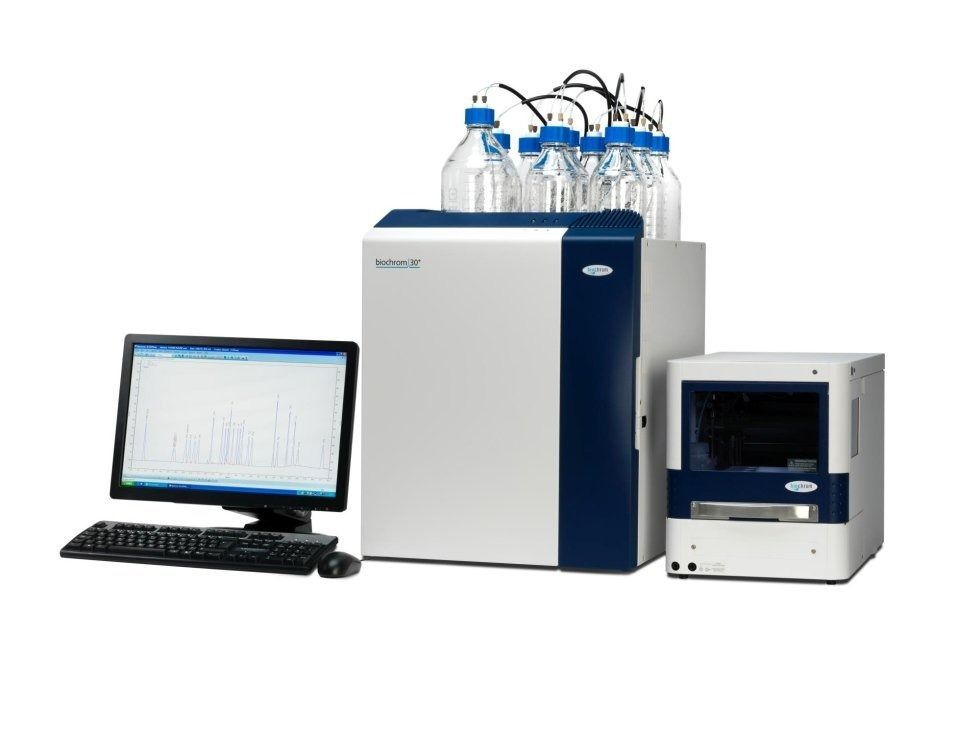
The Biochrom 30 package consists of 4 operating units, one relating to the electronics, one to the pumping system, one to the detection system and finally one relating to the automatic autosampler with automatic Peltier temperature control.
The system also comes with:
Analytical Resin Column for Amino Acid Separation
Precolonna
Complete operating system with interface
Reagents and calibration standards
EZChrom control/acquisition software for Biochrom 30
Ninhydrin Reagent and Buffer Solutions
Instruction Manual
First Aid Tool Kit
Accessories and Consumables Package
Power Cables
New
Here are the main new features introduced in the latest version:
New rapid methods for the analysis of amino acids (Lithium) with a 90-minute chromatogram for 48 amino acids, a program that allows you to save one hour (injection-injection) compared to traditional working methods.
New rapid methods for amino acid analysis (Sodium): a 40-minute chromatogram for 24 amino acids, with a program that cuts analysis time by 33%
New refrigerated and insulated autosampler.
Improved analytical sensitivity.
Improved reproducibility for area and retention time.
The Biochrom 30 is an instrument dedicated to the quantitative and qualitative analysis of all the amino acids of major interest, using cation exchange chromatography with post-column derivatization using ninhydrin. Analytical data are processed using EZChrom chromatography software.
Amino acid analysis is one of the most important applications of liquid chromatography. It is used for everything from routine quality control to medical research projects, where a high degree of accuracy and reproducibility is essential.
Biochrom, with over 25 years of experience in the sector, offers the BIOCHROM 30 model which brings together and leverages the company's experience and knowledge to solve users' needs and problems.
The BIOCHROM 30 is a fully automatic analyzer, specifically designed for the analysis of Amino Acids and capable of obtaining accurate and reproducible results.
The strengths of the system are:
System and Method built on the specifications provided by the customer
High level of applied technology
Completely inert system
Self-diagnostic system for malfunctions
Complete system control via personal computer
These important considerations are the basis for FDA approval, which allows the instrument to be marketed in the United States as well.
Operating principle
Ion chromatography with post-column derivatization
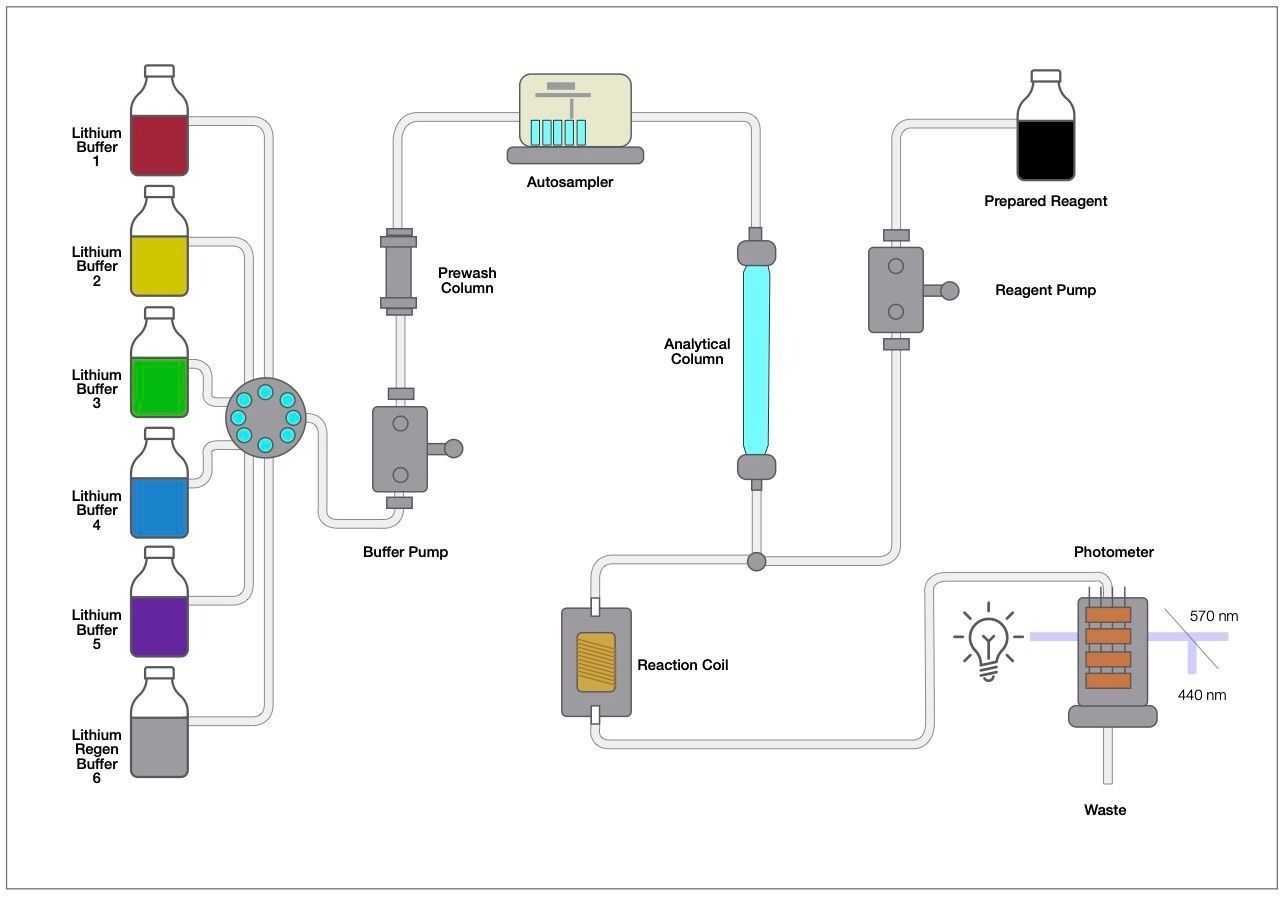
The sample, containing a mixture of amino acids, is injected into a cation-exchange resin column. The eluents (buffer solutions with different pH and ionic strength) are pumped through the column, separating the amino acids according to their specific affinities for the mobile and stationary phases.
The column temperature is carefully controlled and can be adjusted to meet the specific requirements of the separation.
The eluent-sample mixture is reacted with ninhydrin in a dedicated high-temperature reactor.
In the reactor, ninhydrin reacts with the amino acids in the eluate to form a colored compound.
The intensity of the colored compound (amino acid + ninhydrin) produced is directly proportional to the amount of amino acid present.
Learn more
From the reactor, the eluate/amino acid+ninhydrin mixture is conveyed to the photometric detector, where each coloured compound (amino acid+ninhydrin) is quantified by measuring the amount of light absorbed.
Absorbance is measured at two wavelengths (570 and 440 nm) because some amino acids, when bound to ninhydrin, absorb at 440 nm, while others absorb at 570 nm.
The output signal from the photometer is sent to an integrating system that collects the chromatogram and calculates the concentration of the amino acids, displayed as a series of peaks.
The retention time of the peak identifies the amino acid from a qualitative point of view, while the area of the peak is used to calculate its concentration.
To obtain an accurate analysis, the system must be calibrated with a mixture of standard amino acids, from which the data relating to our sample can be obtained at a later time.
After each analysis, the column is regenerated with a strong base followed by the “Buffer 1” solution which re-equilibrates the column before the next analysis.
All operations are performed AUTOMATICALLY by the Biochrom 30 , the operator only has to view the functions and parameters via the control software.
The system is supplied with several analytical methods (standard programs) containing all the information needed to run analyses such as:
Buffer solutions are selected by controlling the valves to create the gradient
Control parameters for the buffer pump and the Ninhydrin pump
Parameters for sample injection
Reactor and column temperature
The time of analysis
Chromatogram acquisition and integration parameters
The instrument's electronics are protected by several safety systems. The Biochrom 30+ consists of two separate units:
Eluent Management Unit
Autosampler Unit
Regarding sample preparation methods and their analytical results, please note:
Free Amino Acids: It is possible to determine free amino acids, without any hydrolysis, only a deproteinization of the sample is necessary.
Total Amino Acids by Acid Hydrolysis: Determination of 15 Amino Acids
Tryptophan not detectable due to loss during hydrolysis
The Methionine/Cystine pair is determined as the sum of the two amino acids (due to overlap)
Glutamine determined as the sum of Glutamine/Glutamic Acid
Asparagine determined as the sum of Asparagine/Aspartic Acid
Basic hydrolysis for Tryptophan determination: total tryptophan determination by basic hydrolysis.
Oxidation plus acid hydrolysis: Methionine and Cysteine separated
Management software
- ICH Q6B - International Conference on Harmonization (of Technical Requirements for Registration of Pharmaceuticals for Human Use)
- IQ/OQ – Installation Qualification and Operational Qualification (Documentation package installation performed on site by qualified engineer)
- ISO 17034 -- Relating to manufacturing of reference standards. Biochrom has the only ISO 17034 grade amino acid reference standards.
- Pharmacopoeia Compliance – Globally recognised set of directions of analytical methods to produce drugs
- 21 CFR Part 11 – FDA regulation on reliability on electronic records Phoenix CFR software and OpenLab or Clarity data analysis package to ‘close the loop’.